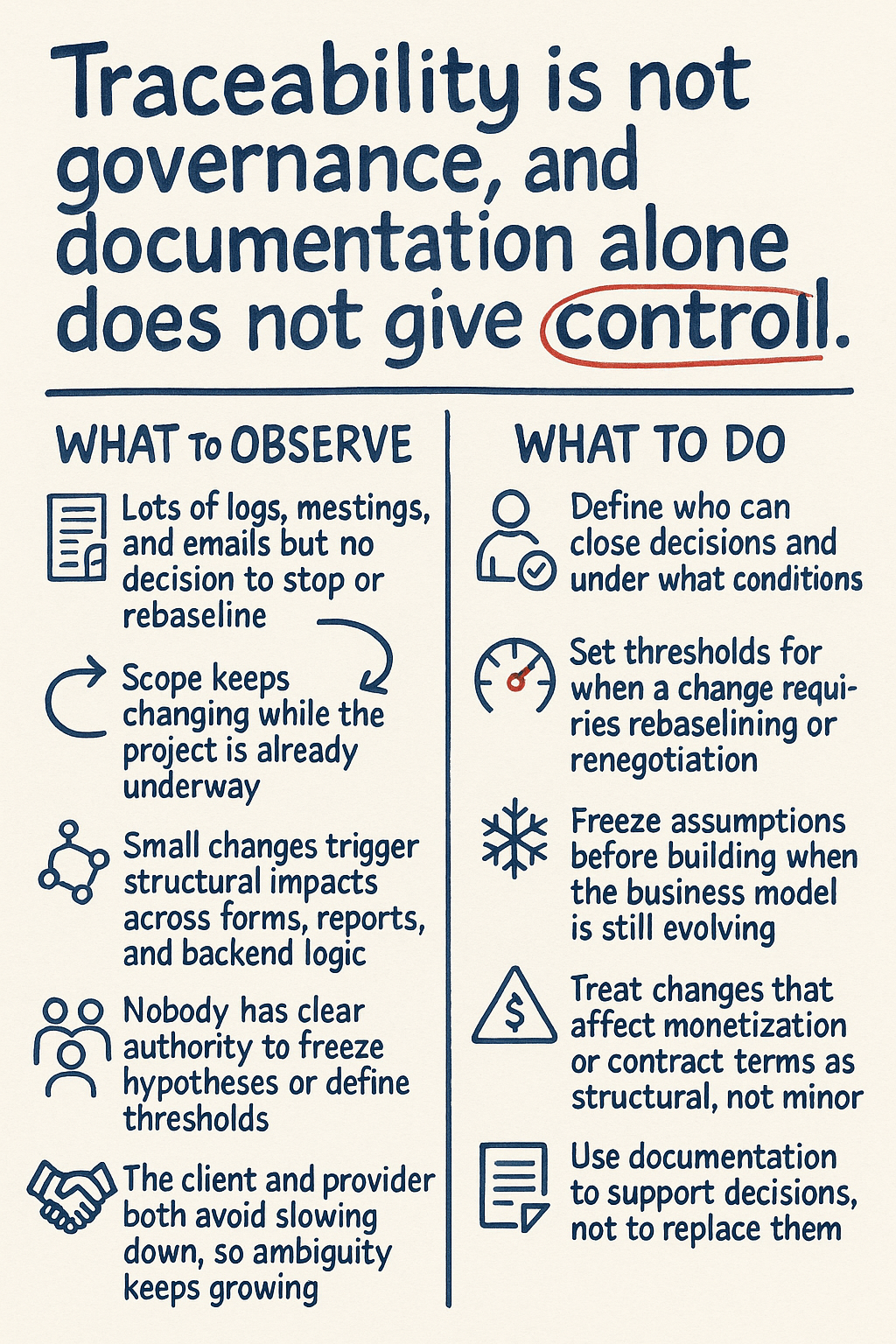
Having traceability is not the same as governing
A few months ago, I saw a project where everything was recorded, but there was no way to stop it, redefine it, or rebaseline it in time, and that is where the difference between having evidence and having real control becomes clear. The documentation conveyed a very convincing sense of order. The problem is that the decision still never appeared, and the operation remained exposed just the same.
In technology organizations, this confusion comes up more often than it should. People believe that documenting a lot is equivalent to controlling well. And yes, a project may have logs, meetings, emails, owners, and immaculate records, yet still be completely outside of governance. The evidence exists. The ability to decide, however, does not quite become clear.
In this case, the platform worked, the team responded, and traceability was there. It worked, it worked (and I stress this a lot), but the project had gone years without a real framework to freeze hypotheses, limit changes, and rebaseline when the business shifted. When that happens, technology stops executing a closed strategy and starts swallowing uncertainty that does not belong to it. And that cost, as always, shows up later.
As a CTO, I draw a strong line between tracking and governance. Tracking tells you what happened. Governance tells you what can keep changing, under which thresholds, and with what consequences. Without that second layer, the project gets trapped in very expensive ambiguity. Everything is recorded, yes, but nothing ever really gets firmly closed.
The context was also delicate. An old operation was being digitized while the client was still understanding its own business model. First, a specific diagnosis was discussed. Then a recurring service with payments, gateways, and new commercial rules emerged. This was no minor evolution. It was practically another product, another contract, and another decision-making architecture.
And here is where the interesting part appeared: when that redefinition happens at the same time as the build, every change stops being functional and becomes structural. A small modification dragged forms, dashboards, reports, and backend logic along with it. The cause was not that the technology “could not handle it.” The scope was still alive while it had already been codified, and that conditions every subsequent adjustment.
Traceability does not replace the decision-making framework. Knowing who asked for what and when helps, of course, but it is not enough. If there is no mechanism to say “this no longer fits,” “this is being rebaselined,” or “this changes monetization and the contract,” documentation ends up working as an organizational alibi. Management appears solid, even though real authority was never defined.
The pattern repeats easily. No one wants to stop. The client avoids freezing because they still have not finished defining things. The provider also does not want to slow down because it is carrying the commercial cost as well. And so work is built on a foundation that seems controlled, even though in reality it is only described in detail.
For a technology leader, the relevant question is not whether the project is documented. The question is whether the organization has real authority to close decisions, protect scope, and accept that certain changes require renegotiating the entire framework. When that does not exist, what appears is inertia with good traceability. The evidence is there, but it does not correct course.
And inertia, even when very well documented, is still inertia.