When the story sounds better than the facts
Why a CTO should not confuse an elegant explanation with a well-made decision.
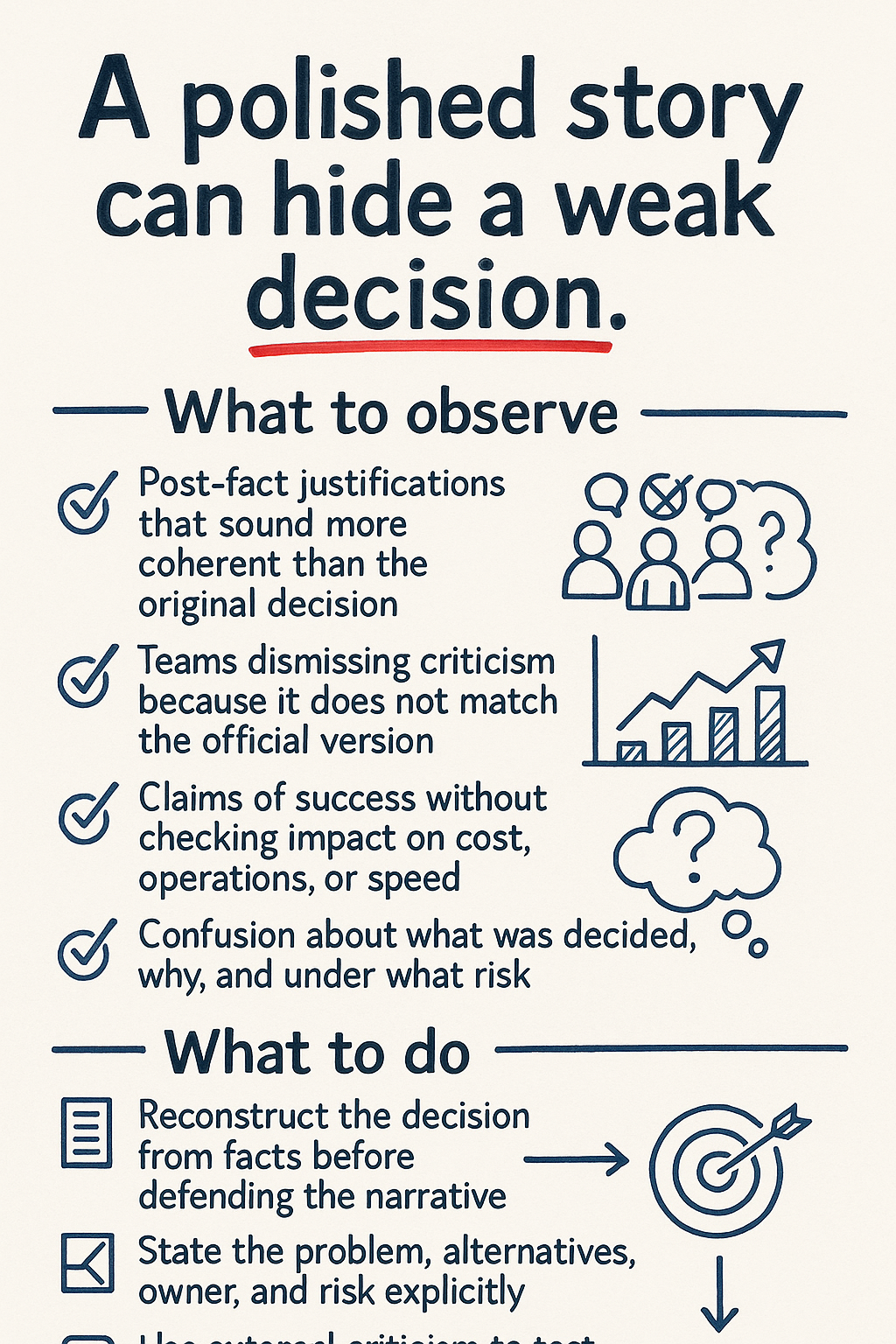
There is a fairly common trap in technology and leadership. When traceability starts to disappear, a coherent story is built, because of course it is always more comfortable to have a tidy version than to accept that you are no longer so sure about what happened. The problem is that a retrospective narrative can make a weak decision look solid, even if in reality it improved nothing.
As a CTO, I have encountered that pattern more times than I would like. An initiative would appear, then defenders would emerge, shortcuts would be justified, and over time the team would end up talking about the outcome as if it had been the natural result of a well-thought-out plan. But explaining afterward is not the same as deciding well beforehand. One thing makes the story fit; the other sustains the business.
What is curious about this is that the defense almost always kicks in at the first challenge. “This is how it has always worked.” “You are not seeing the context.” “That sounds good on paper, but it does not apply in operations.” And yes, sometimes there is context that cannot be seen from the outside, but many other times that reaction only protects the ego and avoids revisiting something more uncomfortable: that the decision was not as well grounded as one wanted to claim. If an observation is dismissed solely because it does not fit the official version, the organization loses the opportunity to review assumptions, detect real resistance, and correct underlying mistakes.
Many companies do not fail because of a lack of ideas. They fail because of too much after-the-fact justification. A decision is made with incomplete information, then it is dressed up as logic, and later it is defended as if that logic had existed from the start. That kills learning, because it mixes fact, interpretation, and desire. And governance also breaks down, because in the end no one knows precisely what was decided, why, with what risk, and under what constraints.
For a technology leader, the consequence is quite direct. If external criticism is not used to test reality, the team stops sharpening its judgment. If an implementation is celebrated without reviewing its impact on costs, operations, or execution speed, all you are doing is moving complexity from one place to another. And if the system rewards convincing narratives over traceability, sooner or later you will repeat the same mistakes, only in different language.
The uncomfortable part is that real discipline consists of reconstructing the facts more accurately. Before talking about architecture, AI, or investment, you need to be able to clearly state what problem was being solved, what alternatives existed, who assumed the risk, and what result the decision actually produced. Without that, the explanation may sound good. But it is not useful for leading. And leading, in the long run, requires precise memory, judgment, and a willingness to review what is uncomfortable.