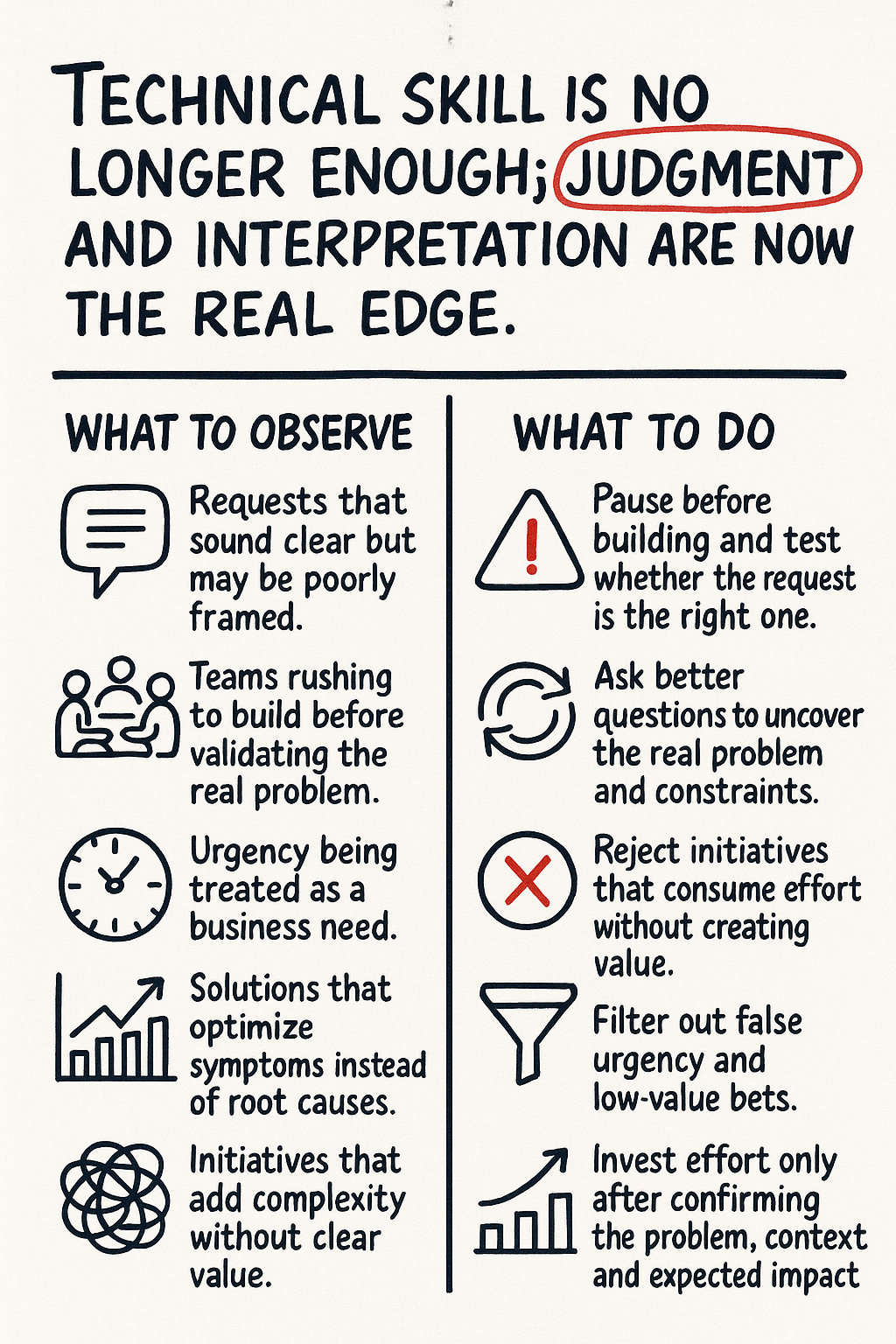
The advantage is no longer in knowing how to do, but in knowing how to read
For years, the conversation about technical capability was oversimplified. It seemed that winning depended on knowing more, mastering more languages, handling more tools, learning more frameworks, and accumulating more certifications. But that ground has been closing quite quickly. AI, accessible documentation, and the standardization of many practices have made the advantage of simply executing well, without going further, shrink considerably.
Execution still has value; there is no doubt about that. What it no longer does on its own is differentiate. It is still necessary, yes, but it is no longer enough to sustain an advantage that lasts. The difference appears when someone interprets the problem more deeply, because that nuance ends up weighing heavily in contexts where every decision affects operations.
The advantage then shifts to another layer: interpreting the problem better before building the solution. For a CTO, that changes almost everything. The highest cost is rarely in writing code; normally, it lies in building, with precision, an answer to a badly formulated question. And that is where useful work is separated from work that only consumes capacity.
When technique is democratized, judgment becomes scarce
Today any team can speed up analysis, prototypes, and documentation with AI support. That lowered the technical barrier to entry and, at the same time, made more visible a difference that used to go unnoticed: the gap between knowing how to do something and understanding whether it is really worth doing. That gap becomes decisive when the pressure to move forward pushes careless decisions, and that is where judgment appears almost as a form of brake against that rush.
That is where executive judgment comes in. Not as romantic intuition, but as the ability to read patterns, anticipate friction, and detect when a request that sounds reasonable ends up being a bad investment. That judgment also helps distinguish between operational urgency and a real business need. With that reading, the organization avoids commitments that seem correct at the time and later become extremely expensive.
I have seen that pattern repeat itself in almost every serious context. The client thinks they need a specific piece. The team rushes headlong to solve it. Weeks later, the real problem appears, usually somewhere else. Inventories that were actually processes. Conversion that was actually segmentation. A product that was actually a pending organizational decision. The technical surface changes, but the root of the problem remains there.
The value is not in responding quickly, but in interpreting well
What I have seen again and again is that the success case does not tell the whole story so easily. Being a good programmer, consultant, or specialist is not enough. What truly opens doors is trust, combined with the ability to go one step further. That extra step gives context to the answer and avoids rushed decisions. It also improves the conversation quite a bit with those who make decisions.
And that extra step is not cosmetic. It marks the difference between acting as a provider or acting as an ally. The provider delivers what was asked for. The ally asks whether what was asked for makes sense. And that tension is useful, because it avoids one of the most expensive traps in technology: optimizing a flawed solution. When that conversation happens early, the cost of correction drops clearly.
For a CTO, the implication is quite direct. Not every opportunity deserves architecture, and not every brief deserves a roadmap. Sometimes the best decision is to stop, ask better questions, and reject an initiative that consumes energy without creating value. That discipline protects the team’s capacity and improves the quality of the outcome.
Technological maturity also means knowing where not to invest
The market rewards those who know how to build, but increasingly it rewards those who know how to filter. Filter noise, false urgencies, bets that seem strategic and only add complexity and debt. That filter protects the team’s real capacity and prevents effort from being scattered across less relevant fronts. It also preserves focus for the problems that truly deserve attention.
That filter requires experience and also independence of judgment. When an organization confuses volume with progress, it overburdens the people who see the risks best and lets pass opportunities that actually had potential. The consequence usually appears late, when correction already costs more than expected. At that point, the bill usually includes time, credibility, and room to maneuver.
The advantage is no longer in mastering more tools. It lies in better interpreting the context, better formulating the problem, and deciding with greater judgment what is worth investing in. For a CTO, that is the difference between a team that produces deliverables and a function that improves the quality of business decisions. And that difference, in the end, is what ends up marking the organization’s true maturity.