The minimum control the system was already asking for
A few months ago, I came across a critical platform that affected operations, security, and money, and the real dilemma was not whether we should slow the business down, but how much risk was already being accepted without saying it out loud. At that point, you were no longer debating processes; you were debating consequences, and the kind that end up being expensive later.
The problem is continuing to operate as if it were still not needed
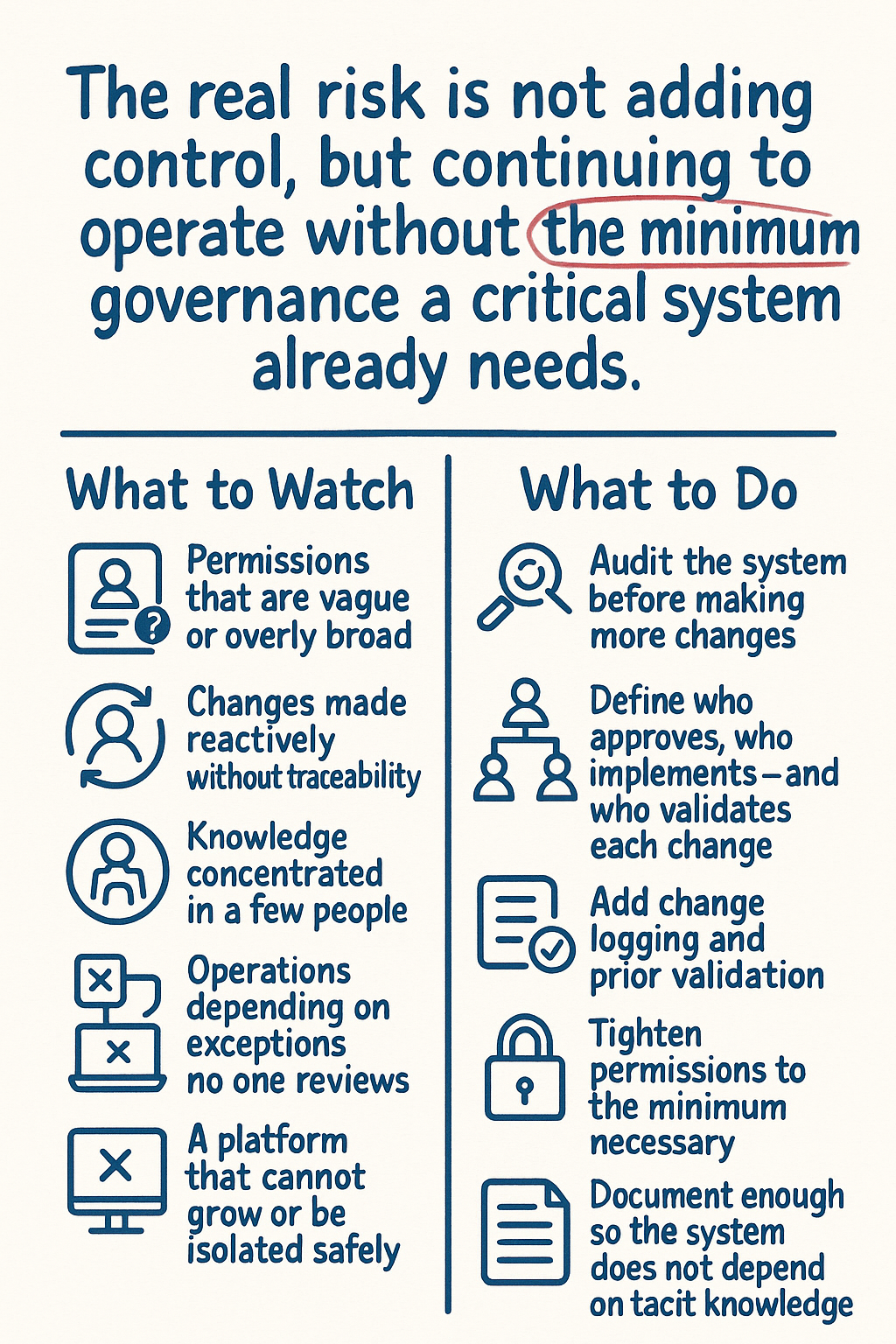
In many organizations, the idea of not adding more process sounds pragmatic, but most of the time it is only masking a decision that no one wants to make. As long as the platform responds, inertia does the work. Then urgent changes arrive, exceptions multiply, permissions expand, and knowledge ends up concentrated in a few people.
That looks like speed for a while. Then it stops being speed. The cost appears when the operation already depends on exceptions that no one reviews, and that is when the supposed smoothness turns into accumulated fragility.
As a CTO, I care less about arguing whether control slows things down and more about understanding what risk you are accepting when you avoid it. In a critical system, the absence of governance does not eliminate complexity. It only hides it. And what is kept out of sight usually ends up inside the incident.
Bureaucracy and operational governance are not the same thing
The difference is quite simple, although it is rarely explained well. Bureaucracy is adding steps that do not improve the decision. Governance is defining the minimum path so a platform can change with traceability, be validated with judgment, and be audited without relying on the memory of two people.
That threshold had already been crossed. The platform had grown on a centralized foundation, with vague permissions and reactive changes. The team was small, yes, but criticality has little to do with size. It has to do with the impact on operations, data, legal exposure, and security.
That is where the usual dilemma appears. If you control more, it seems like the business slows down. And often the opposite is true. What really slows things down is not having defined who approves, who implements, who validates, and how all of that is recorded.
Control stops looking like a cost when it prevents risk from continuing to accumulate
Before moving anything, the right thing was to audit. Not to check a box, but to understand what real risk the company was taking on. That review confirmed something that was hard to ignore: touching the system without order could make the problem worse.
The security test was quite clear. In less than ten minutes, it was shown that a user could manipulate flows to trigger purchases worth close to 3,000 euros. There was no need to imagine an extreme scenario, because the risk was already operational. And on top of that, there was an architecture that would not allow safe growth or the isolation of parts of the system without compromising the whole.
From there, rebuilding stopped being a radical decision and became a prudent one. It was faster than continuing to patch things, cheaper than stretching a fragile foundation, and more aligned with the need to operate without leaving continuity in the hands of luck. Minimum control started to look like a working condition, not an added burden.
The minimum circuit a critical platform needs
The lesson is not to govern everything. It is to define the indispensable minimum. Functional and technical ownership, change logging, prior validation, clear permissions, and enough documentation so the system does not depend on tacit knowledge.
That minimum is not a luxury. It is the condition for continuing to evolve without losing control. The question is no longer whether governance should be added. The question is how long an organization can keep calling improvisation agility when it already has an operational cost.
When that question is answered honestly, the discussion changes tone. It is no longer about protecting the way of working, but about protecting the ability to keep operating. And there, control stops being a defensive gesture and becomes a mature decision.