The Company That Lives Inside a Single Head
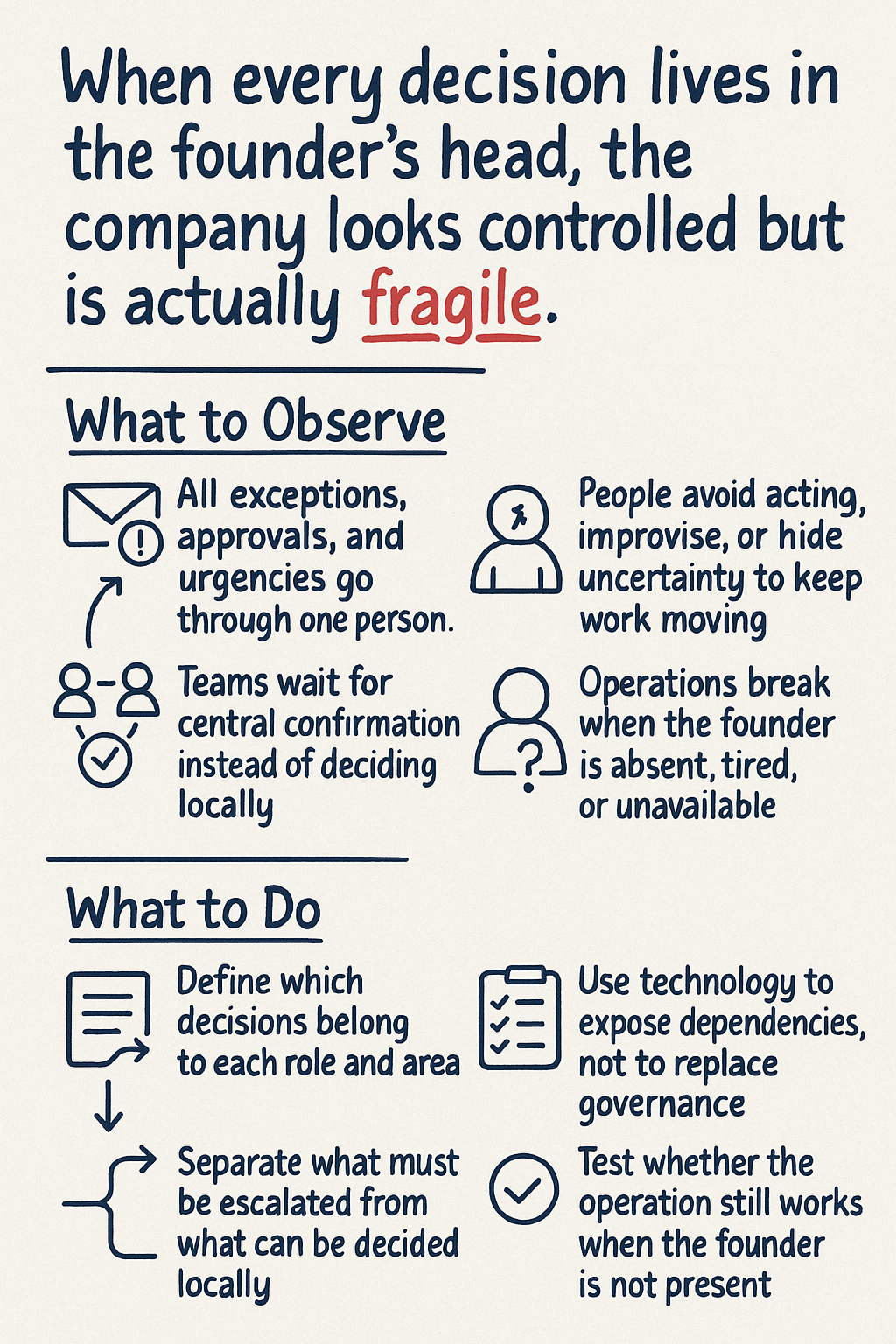
When the founder becomes the bridge between teams, the one who validates special cases and the final authority to decide everything, the company stops being supported by processes and starts depending on one person. At that point, each area waits for a central approval, and that ends up slowing down operational judgment. The structure may still give the appearance of order, but underneath it is already quite fragile.
There are companies that seem to work until someone looks at where decisions are actually made. That is when the pattern appears, because everything ends up in the same head. Not only exceptions, but also the interpretation of rules, the validation of urgencies, the coordination between areas, and even the authorization to operate all become concentrated in the same place.
From the outside, that can look like control. From the inside, it is usually fragility. And that difference explains why some organizations keep moving while accumulating a dependency that is no longer healthy.
That happened to me at a veterinary clinic with multiple shifts and an operation that no longer allowed improvisation. The owner was doing several things at once and, for a while, that model even seemed to work. But when the shifts grew, operational pressure increased, and the operation became more sensitive to inventory, billing, and clinical compliance, centralization stopped holding up. It was not a lack of commitment. It was too much dependence placed on one person.
That is the mistake many of us end up seeing too late. A company can keep responding long after it has lost predictability. And without predictability there is no system, only improvisation sustained by an exhausted person, while everyone else adjusts their behavior to avoid running into uncertainty.
The hidden cost does not stop at the founder’s fatigue. The organization starts putting its way of working inside their head. Rules stop living in processes and start living in memory. Exceptions are no longer resolved through distributed judgment, but through personal intervention. The team stops executing a system and starts guessing what management expects. And from there, operational trust begins to erode: people protect themselves, wait, leave things out, find shortcuts, or simply walk away.
In this case, the team went from 15 people to 3. That figure does not point to a software problem. It points to an organizational architecture problem, because the way decisions were made ended up absorbing the capacity to sustain daily work.
The answer was not to add technology just for the sake of it. First, governance had to be reorganized and it had to be defined which decisions belong to each area, which ones are escalated, which ones are tracked, and which can no longer depend on one person being available, physically or emotionally. The ERP with electronic medical records did not solve the root cause, but it did make very clear what had previously been hidden in informal habits. Inventory, pharmacy, emergencies, and records stopped moving through gray areas and began to have traceability, access control, and assigned accountability.
For any CTO, the lesson is quite simple. Technology does not fix a weak governance model by itself, but it does show you with great precision where the real dependency lies. If a clinic, a factory, or a startup cannot operate unless the founder approves everything, the problem is not that the business has "grown." The problem is that the system never stopped living inside a single head.
The real question is not how much load one person can تحمل. It is how much of the operation still works when that person is not there. If the answer is almost nothing, then the problem is not the calendar. It is the design.