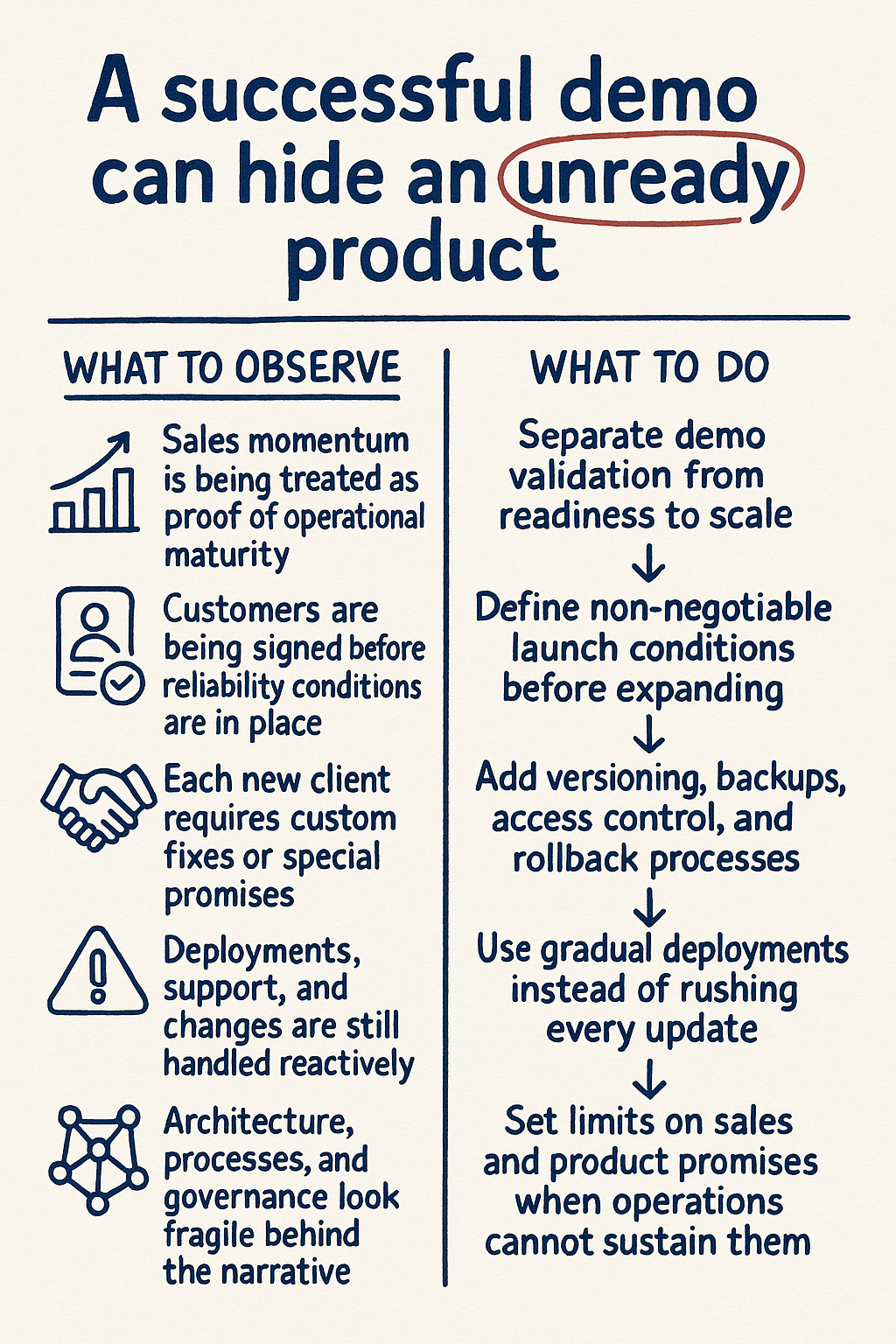
A demo that goes well is often received as good news. And yes, it can be. But it can also be misleading if the company takes it as proof of operational maturity, because at that point the commercial conversation starts to weigh too heavily before the real capability is ready.
From a CTO’s perspective, that mistake is costly in B2B. A demo shows that something can be presented. It does not show that it can be deployed, supported, versioned, maintained, adapted, and sustained without breaking either the customer’s operations or the company’s own. And the distance between those two things usually says quite a lot about the quality of technical leadership.
I have seen products that were already entering companies without having closed the minimum conditions of reliability. Commercial interest opened conversations and initial rollouts, and on paper that looked very good. Then incidents came, rework, team wear and tear, and growing pressure on support and development. The failure was not in selling too early. It was in confusing demand with readiness.
And here appears a nuance that many organizations prefer to overlook. The market may react with enthusiasm while architecture, processes, and governance remain fragile. When that happens, the commercial pipeline is not showing strength. It is hiding the lack of it. And to read it properly, you have to look at operations more closely than at the narrative.
A demo does validate the value proposition, the story, the initial fit, and the ability to spark interest. That is something. Even so, it remains the first threshold. It can show that the problem is worth discussing, not that the solution is ready to operate in real conditions. That difference ends up shaping many decisions later on.
If the company uses that signal to accelerate without control, complexity grows quickly. Unstable versions begin to appear, improvisational changes, reactive support, specific promises for each customer, and a level of customization that ends up looking like consulting disguised as a product. Each new customer stops being a clean test of traction and instead adds operational debt. The organization ends up paying for every shortcut with more internal load.
The CTO’s role is not to stop the market. It is to define which conditions make scaling acceptable. That is where the change came when controls that had not existed before were introduced, such as versioned backups, access management, gradual deployments, rollback, and more discipline around data and changes. The pace slowed down, yes. The risk of turning every update into a crisis also went down. That decision protected service continuity.
That kind of decision often creates friction because it forces people to say no. To sales, because it limits promises. To product, because it reduces room for improvisation. To the organization, because it makes clear that growing is not only about selling more, but about delivering better. Technical judgment gains value when it sets useful limits.
If a team celebrates a demo as proof of maturity, it is probably rewarding narrative over evidence. In B2B, that is paid for in margin and trust. The sense of progress may not last long when operations start accumulating exceptions.
The useful question is not whether the demo works. It is whether the company can sustain the system when it has ten times as many customers, more changes, and higher expectations. If that answer is not defined, the problem is not commercial. It is one of technological leadership. That is usually where the CTO’s real work begins.