When nothing happens, risk still accumulates
A few months ago, I had to review a critical platform that, at first glance, seemed “fine” because it wasn’t going down, it wasn’t raising alerts, and nobody mentioned it in meetings. But the reality was different: that calm also hid a fragility that had been growing for some time and that, if left unchecked, becomes much more expensive to fix later. And no, it wasn’t that the system was “at peace”; it was that the organization had confused operational silence with true health.
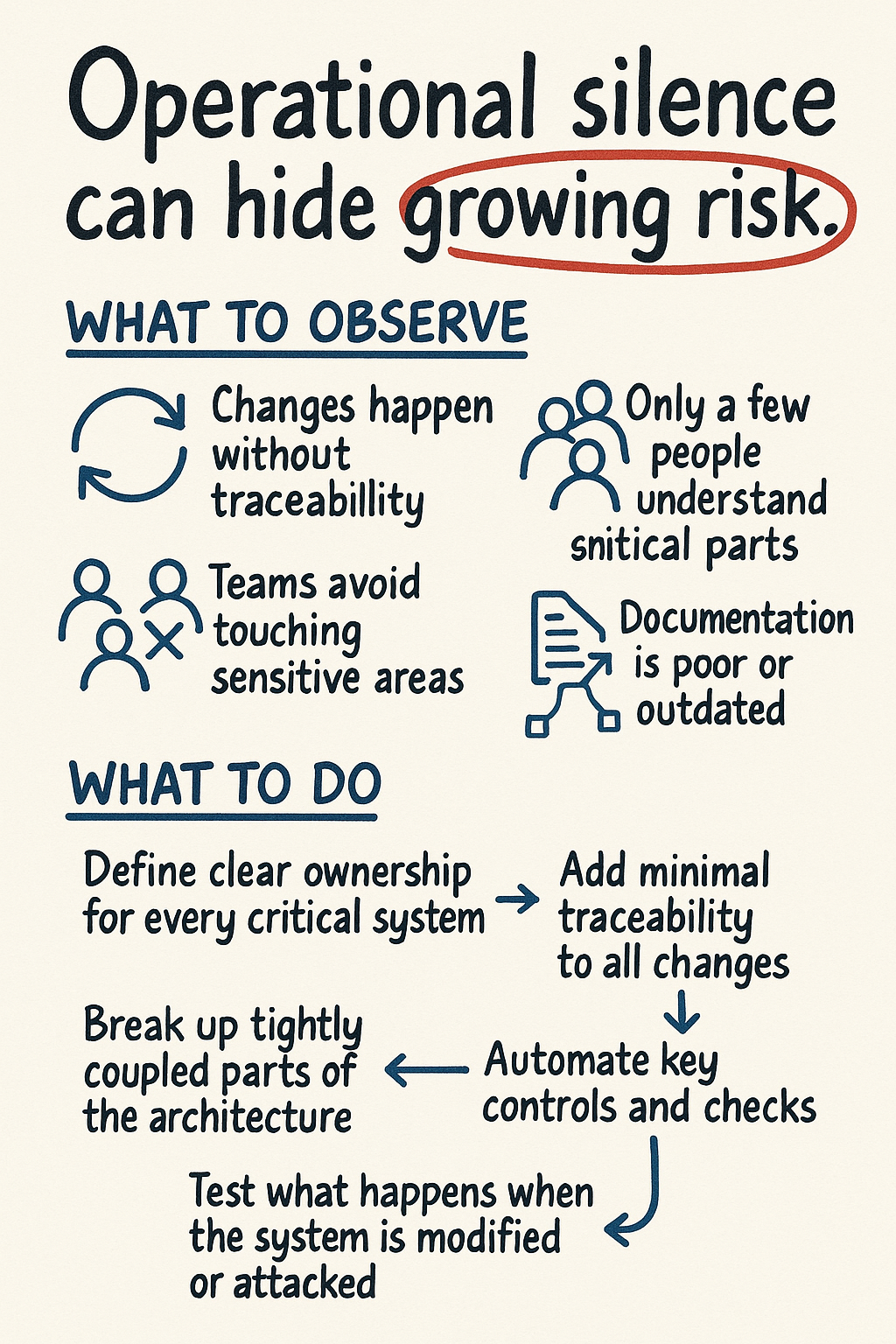
That kind of fragility almost always builds quietly. It feeds on technical debt, vague permissions, changes without traceability, dependence on two or three people, and an architecture that is already hard to touch. Over the months, what seemed like control turns into habit, and habit is deceptive because it makes you believe everything is under control when in reality you are only kicking the problem down the road.
As a CTO, I have learned that apparent calm can also hide an accumulated burden. The question that really matters is not whether the platform is making noise, but whether it can still be changed without putting at risk what sustains it. And that is usually where the uncomfortable answers emerge.
The wrong signal
Many organizations believe a platform is doing well as long as it does not disrupt operations. It does not generate warnings, it does not cause outages, and it does not create work for anyone. But that reading mixes apparent continuity with real resilience, and ends up rewarding stillness as if it were a virtue.
The system I had in mind kept working normally in day-to-day operations. The problem was that that normality was hiding a reality that was far less comfortable for those operating it. There was no clear ownership, decisions were made on the fly, and the company had been relying on shortcuts for quite some time.
Everything worked, yes, but only as long as nobody had to touch a sensitive part. At that point, the real cost of not having a shared standard became visible. From the outside it looked efficient; from the inside it was accumulated risk, the kind nobody wants to name until it can no longer be pushed aside.
The absence of failures does not prove safety
The most useful test was not asking whether the system had failed. It was seeing what happened when someone tried to modify or attack it. The audit made it clear that the risk surface was still there, even if operations looked calm.
In a controlled security test, it was demonstrated in less than ten minutes that a user could manipulate flows and end up generating purchases worth about 3,000 euros. The purchase was not executed, but the demonstration was enough to change the conversation in the committee, because the problem was no longer theoretical.
That is where the difference between functioning and being resilient becomes clear. A system can support day-to-day operations and, at the same time, not be ready to absorb a change, an audit, or even moderate growth without exposing itself. That is usually discovered too late, when pressure is already forcing you to act.
What an executive committee should look at
There are early signals that deserve attention even if there are no visible incidents yet. Urgent changes without records, fear of touching certain parts of the system, poor documentation, dependence on a third party or a single person, and an overly centralized architecture form a fairly clear pattern. And that pattern, honestly, usually points to bigger problems ahead.
When that pattern appears, the right question is not whether something has already happened. The real question is how much longer the company can keep going without paying a higher price. In many organizations, that answer ends up defining the true room for decision-making.
And the answer is rarely “keep going a little longer.” Usually, the right move is to organize before continuing to change things. Defining ownership, introducing minimal traceability, modularizing the architecture, and automating critical controls helps restore the ability to evolve without turning every change into a gamble.
Real stability is measured by the future
A system that never causes problems can still be a bad system for the business if it cannot safely support change. That is the lesson that matters most to a CTO. The health of a platform is not measured by the calm of the present, but by the kind of risk it is still hiding.
If we cannot change it without putting operations at risk, then we do not have stability. We have a pause that looks like control while complexity keeps growing underneath. And the organization ends up paying for that illusion with more effort, more risk, and less room to maneuver.
That pause is often the point where a decision is needed. The company can keep living on inertia, or it can recover discipline before the risk finds a more expensive way to show up. At that point, what matters more: acting with judgment or continuing to sustain the appearance of calm?