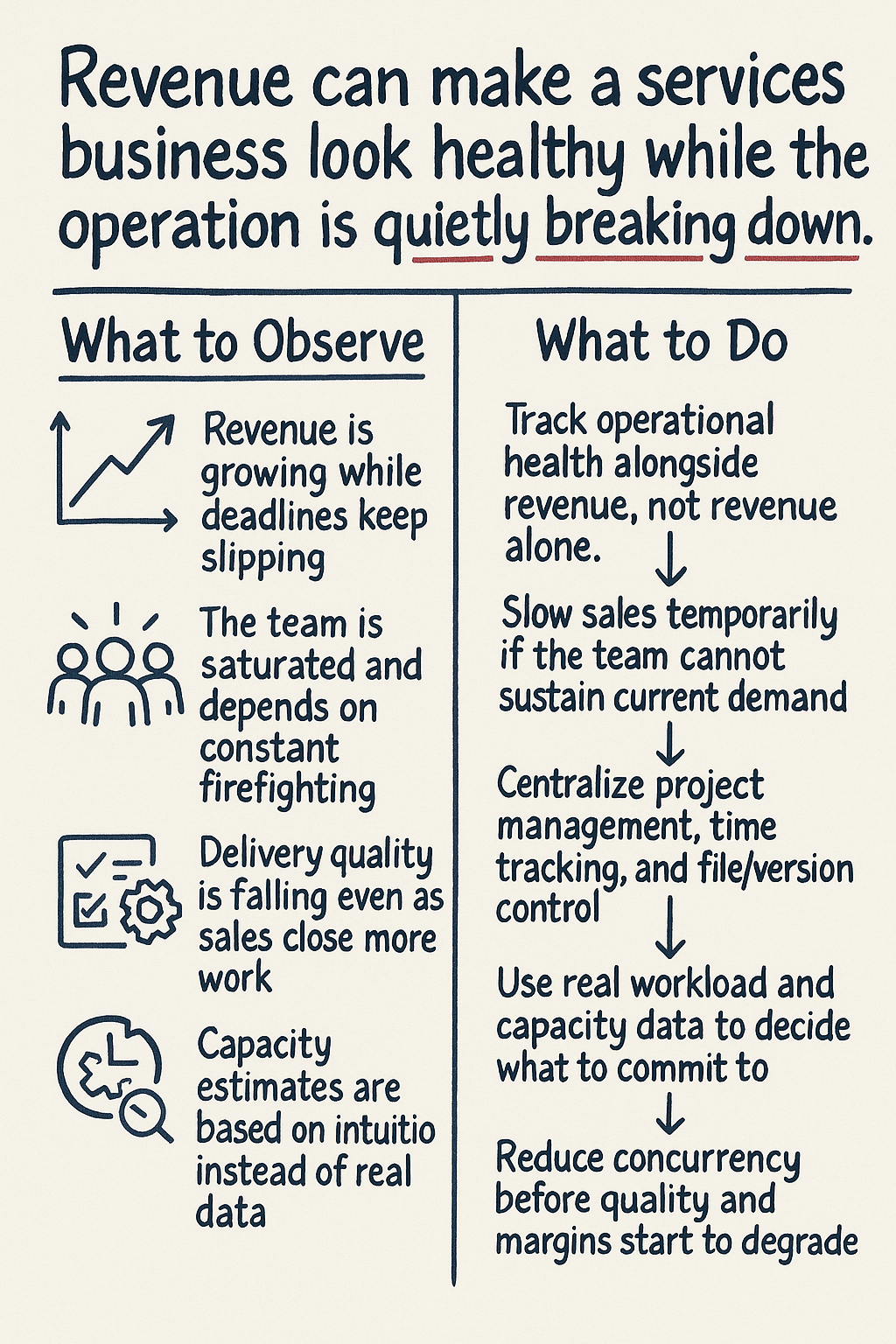
There is a very convenient way to fool yourself in a services company: look at revenue and assume everything is going well. I have come across organizations that, from the outside, seemed to be growing quite healthily, but when you dug into the operation, what you found was more friction, more urgencies, more rework, and less real capacity to sustain what was being sold.
That is the fundamental mistake. Measuring success with a single metric leaves out signals that matter much more than they may seem. The company ends up reading only part of the picture and losing the full view it needs to make decisions with any real judgment.
As a CTO, I have encountered far too many organizations that optimize revenue without measuring the health of the system that produces it. And when that happens, the operation deteriorates even though the profit and loss statement does not yet show it. Commercial activity goes up, but organizational solidity goes down. And that difference, which at first seems small, eventually consumes the whole scenario.
The case in front of us shows it quite clearly. The company was still closing work, but the team was saturated, deadlines were stretching out, and coordination depended on scattered tools and informal judgment. There was no real visibility into hours, bottlenecks, or critical dependencies. It was selling with a false picture of capacity, and that always comes at a cost in the end.
Revenue does not distinguish between profitable work and work that destroys operating margin. It also does not separate a well-delivered project from one that quietly consumes hours, strains the team, and leaves the client dissatisfied. If you only look at revenue, you can end up rewarding exactly what is degrading your execution. And there the trap is quite obvious: apparent growth ends up weakening the business.
The fix came through better governance. Commercial activity was temporarily slowed down in order to organize the operational base, bring in the missing staff, and centralize project management, versions, filing, email, and time tracking. The decision was hard, because it meant accepting that growing without control had a higher cost than stopping in time. The trade-off was clear: less short-term volume in exchange for an operation capable of sustaining itself.
From there, the conversation changed. The question stopped being how much they could bill and became how much they could commit to without degrading delivery. The team started estimating with real data rather than intuition. Concurrency went down, quality went up, and daily pressure stopped dominating the operation.
The lesson for any technology leader is quite simple. A single metric leaves you blind. If revenue is the only thermometer, you can miss early warning signs such as fatigue, delays, rework, loss of focus, or that excessive dependence on internal heroics that some companies still celebrate as if it were a virtue. When those signs appear, the problem is no longer commercial. It is one of operational governance. A services business breaks when it confuses revenue with health.
The CTO’s job is to avoid that illusion and build a system where growth does not mean degradation. That discipline is what separates an organization that sells more from an organization that can sustain what it promises.