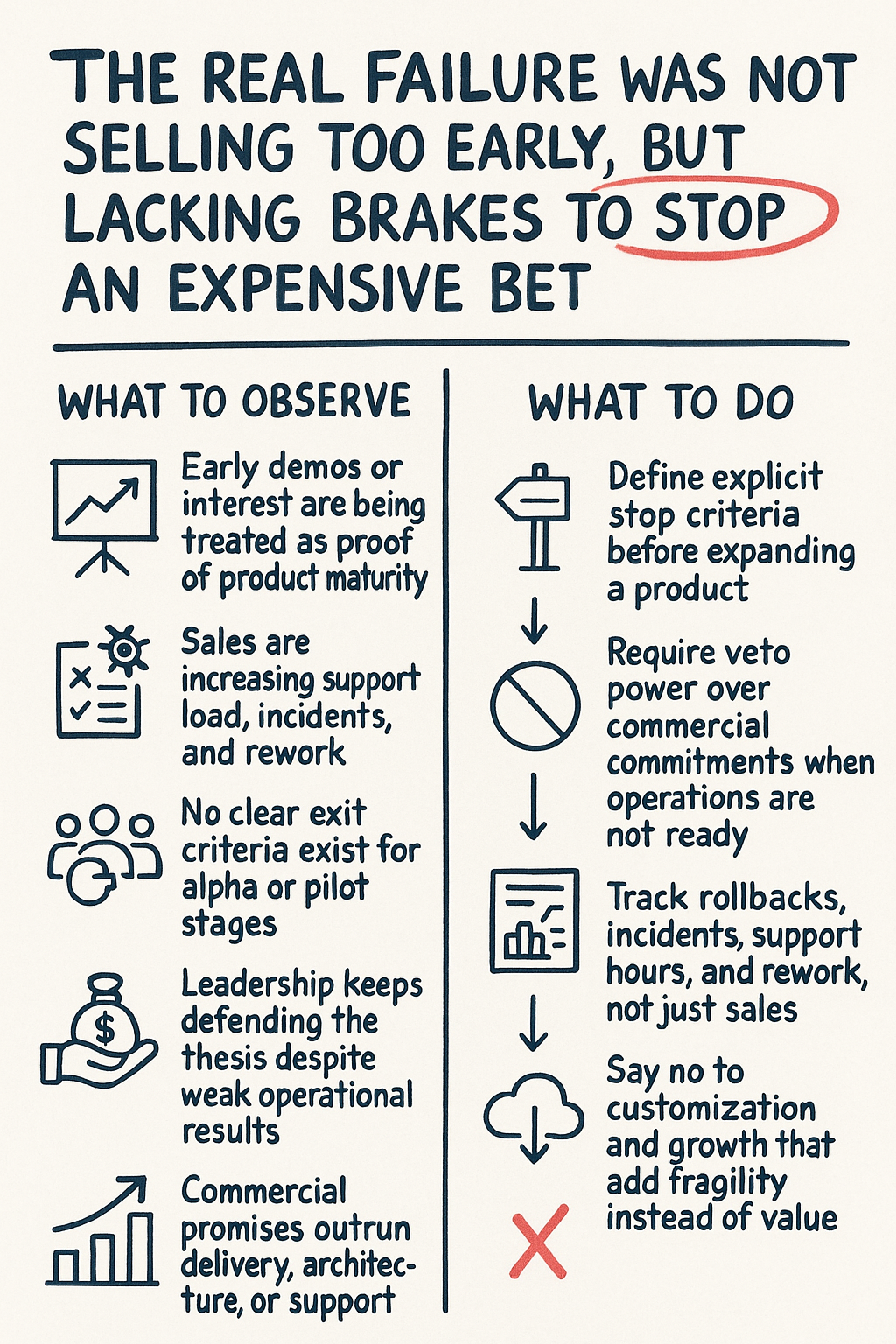
The problem was not selling too early
There were decisions that did not fail because of a lack of market, but because of a lack of brakes. And for a CTO, that difference matters quite a lot, because validating an opportunity is not the same as letting an immature bet keep consuming cash, credibility, and the team’s time as if nothing were happening. One thing is to test something, and something very different is not having a way to stop when it has already become obvious that the experiment is getting expensive.
The mistake was not launching a B2B ERP in alpha. The problem appeared when no decision-making system was set up that would allow the expansion to stop precisely at the point when it was already obvious that the learning curve was destroying more value than it was creating. The organization kept moving forward without a real exit criterion, and that absence ended up shaping everything that came after.
That is where the diagnosis changes. When a company does not define which conditions must be met to keep moving forward, the conversation stops being technical and becomes one of governance. And when that governance is missing, narrative ends up taking the place of evidence, which is exactly where the real problems begin. Leadership ended up protecting a hypothesis that no longer had operational support, but continuing to defend it was more comfortable than accepting the blow.
Selling is not the same as sustaining
For a while, the team interpreted the first demos, commercial interest, and some customers’ willingness to try the product as sufficient signals to push harder. And honestly, that reading was dangerous. There was conversation, yes. There was learning too. But there was no repeatable delivery capability, and that difference marked the entire journey.
That nuance matters a lot in B2B. If the architecture, processes, and support are not stabilized, every sale adds complexity instead of removing it. More incidents start coming in, more rework, more pressure on development, and more reputational risk. Growth stops helping and starts multiplying fragility. In the end, operations are left with no room to absorb errors.
The organization experienced that very clearly. There were versions that had to be rolled back, recurring errors, constant patches, overwhelmed support, and a commercial experience that deteriorated precisely when it most needed to build trust. The product needed discipline, but the company was still responding with urgency, which in cases like this is usually just another way of covering up the problem.
The real problem was authority
The signals were there. The problem was that signals are not enough if no one has the authority to act on them. That is the core of the story. Many companies do not fail because they do not know what is happening; they fail because they cannot stop. The information was there, but it was not turning into decisions.
The team trusted that it could still be corrected on the fly. The detail is that correcting a decision is not the same as questioning the founding thesis behind it, and that costs a lot more than it seems from the outside. Sooner or later, someone has to ask whether commercial expansion validates the product or whether it is only delaying an inevitable correction. That question, more than any pretty dashboard, is what tells you how mature the management really is.
That requires a real veto right over commercial promises, clear criteria for exiting alpha, and metrics that measure not only sales, but also rollbacks, support hours, incidents, and rework. Without that framework, the discussion gets trapped in perceptions. With it, the company can finally decide with something close to judgment.
Governance also means saying no
The correction came with stronger controls. Versioned backups were introduced, deployment management became stricter, rollback was implemented, customization limits were set, and the operating model became less improvised. The effect was immediate: apparent speed went down and real control went up. Operations gained order without losing focus.
That is uncomfortable because it forces a shift from the logic of excitement to operational discipline. In B2B product, that change is not optional, even if it is sometimes sold as if it were a minor detail. Without it, the internal narrative ends up shielding decisions that no longer hold up, and the pressure to sell stops justifying every shortcut.
The lesson for a CTO is pretty straightforward. It is not enough to build. You also have to design the system that allows you to stop on time, because a mature company is not the one that promises more, but the one that knows when a bet has stopped creating value. And, seeing how many organizations behave when the numbers start to please them, who really has the authority to say that it ends there?