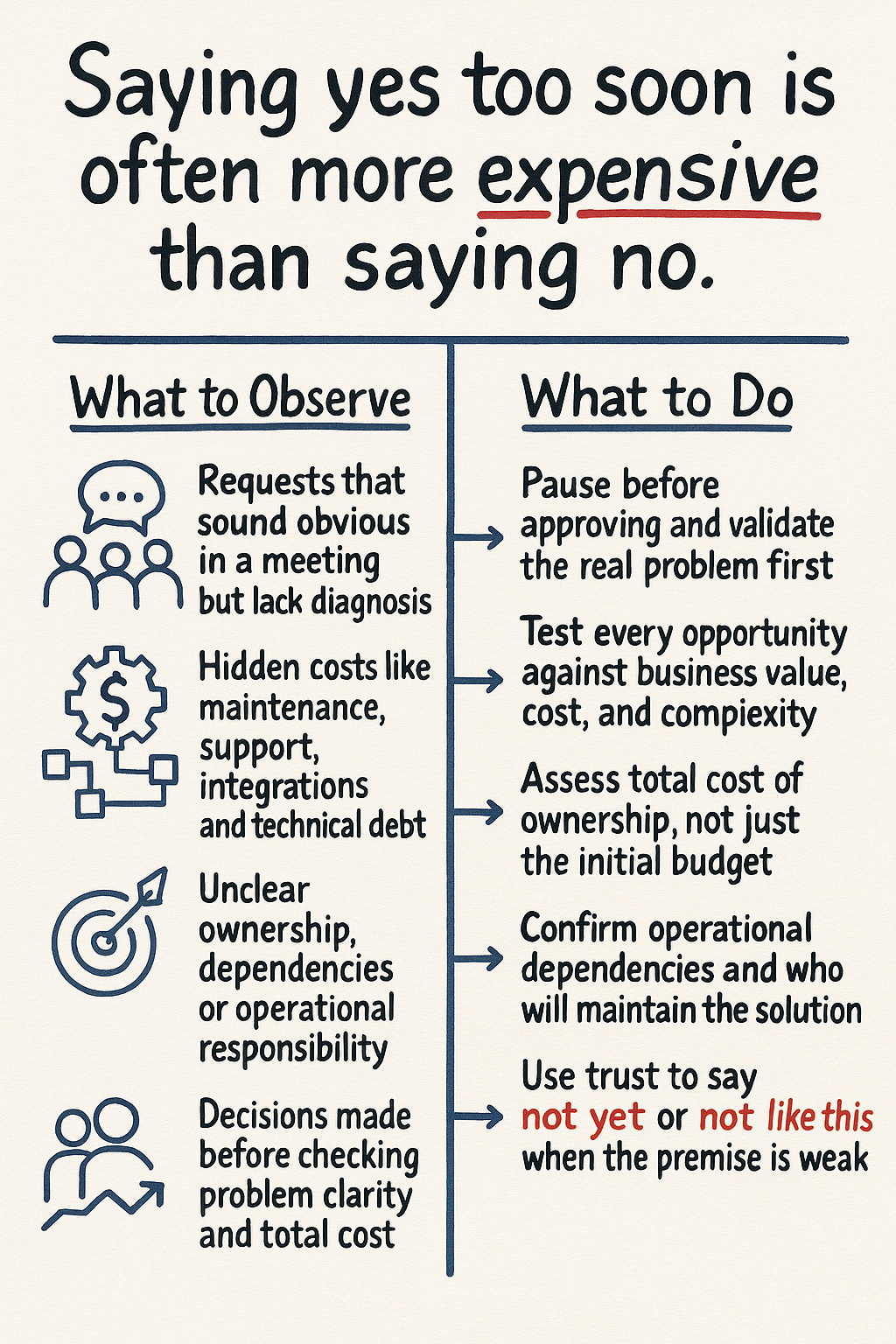
The most expensive mistake is not saying yes. It is saying yes too soon.
In technology, we tend to applaud the speed of decision-making, but the truth is that rush can also destroy value. A few months ago, I came across B2B decisions that were being approved before passing through a serious filter of value, cost, and complexity, and the hit almost always came later, when commitments had already been made that were no longer easy to undo.
I have seen too many projects start as if they were obvious opportunities and end up turning into operational debt. The idea sounded good, but nobody stopped long enough to ask enough questions. What problem it really solved, who was going to operate it, what dependencies it was introducing, how much it would cost to maintain in six months, what would happen if the initial hypothesis failed. When those questions came too late, the margin was already suffering.
The difference between an apparent opportunity and an investable opportunity lies exactly there. The first one usually sounds good in a meeting. The second one withstands a business, architecture, and execution review without collapsing at the first sign of pressure. That difference separates impulsive decisions from those that truly sustain real growth.
The case that inspired this leaves a fairly clear lesson. It is not enough to be technically good. You also have to look beyond the client’s literal request, because the problem is almost never exactly where they are pointing to it. A solid criterion starts before writing a single line of the solution.
A client may ask for an inventory solution, a landing page, or a platform. That does not mean the problem is there. It may be in supply, in poor design, in human friction, in a poorly resolved integration, or in an unresolved organizational decision. If a vendor responds only to the symptom, they deliver speed. If an ally questions the premise, they deliver value.
From a technology leadership perspective, this is where the uncomfortable part appears. Accepting a request without diagnosis usually pushes complexity into the future, and that complexity ends up costing margin, focus, or both. The pressure to move fast rarely compensates for that accumulated effect.
Most technology investment mistakes are not visible in the initial budget. They show up later, when maintenance, dependence on key people, integration with existing systems, support, security, scope changes, and technical debt come into play. Then the decision is no longer a promising idea and becomes an operational burden.
That is why judgment matters more than speed. The question is not only whether we can build it. The question is whether it makes sense to do it now, with this structure, for this problem, and with this level of uncertainty. That assessment prevents commitments that later consume energy for months.
Relationships matter too, but not as a business shortcut. They matter because they allow for an honest conversation. When there is trust, you can say not yet or not like this without breaking the relationship. That clarity protects the organization from pouring money into poorly defined bets.
Before moving budget or team, I would look at three things: problem clarity, total cost of ownership, and operational dependency. If an opportunity does not pass that filter, it is not an opportunity. It is a well-presented distraction. That kind of discipline preserves focus and credibility.
Maturity is not about accepting more work. It is about choosing better where to put energy. Because saying yes too soon does not accelerate the business. It exposes it. And when exposure grows, the company ends up paying for decisions that seemed harmless.