When software tries to decide for the company
Digitizing does not save you from making a strategic decision. Rather, it makes it more exposed, and if you introduce it too early, it also ends up costing you more. Technology can indeed speed up an organization, but it can also magnify its gaps when leadership has not yet defined where it is heading.
And here comes the usual temptation in technology: if a process already exists, it seems logical to move it into software and consider it done. The problem is that many times the organization still does not know which part of its business it wants to stabilize and which part it prefers to keep exploring. At that point, the tool ends up carrying an ambiguity that, in reality, still belonged to the business.
That nuance changes the project completely. A few months ago I was looking at an HR consultancy that had been operating with paper, Excel, macros, and presentations. Digitizing made sense, yes, but the model that was supposed to support that digitalization was still open. The team began building while fairly basic doubts were still lingering about what was monetized, what was automated, what needed to remain flexible, and what commercial risks the new system was going to take on.
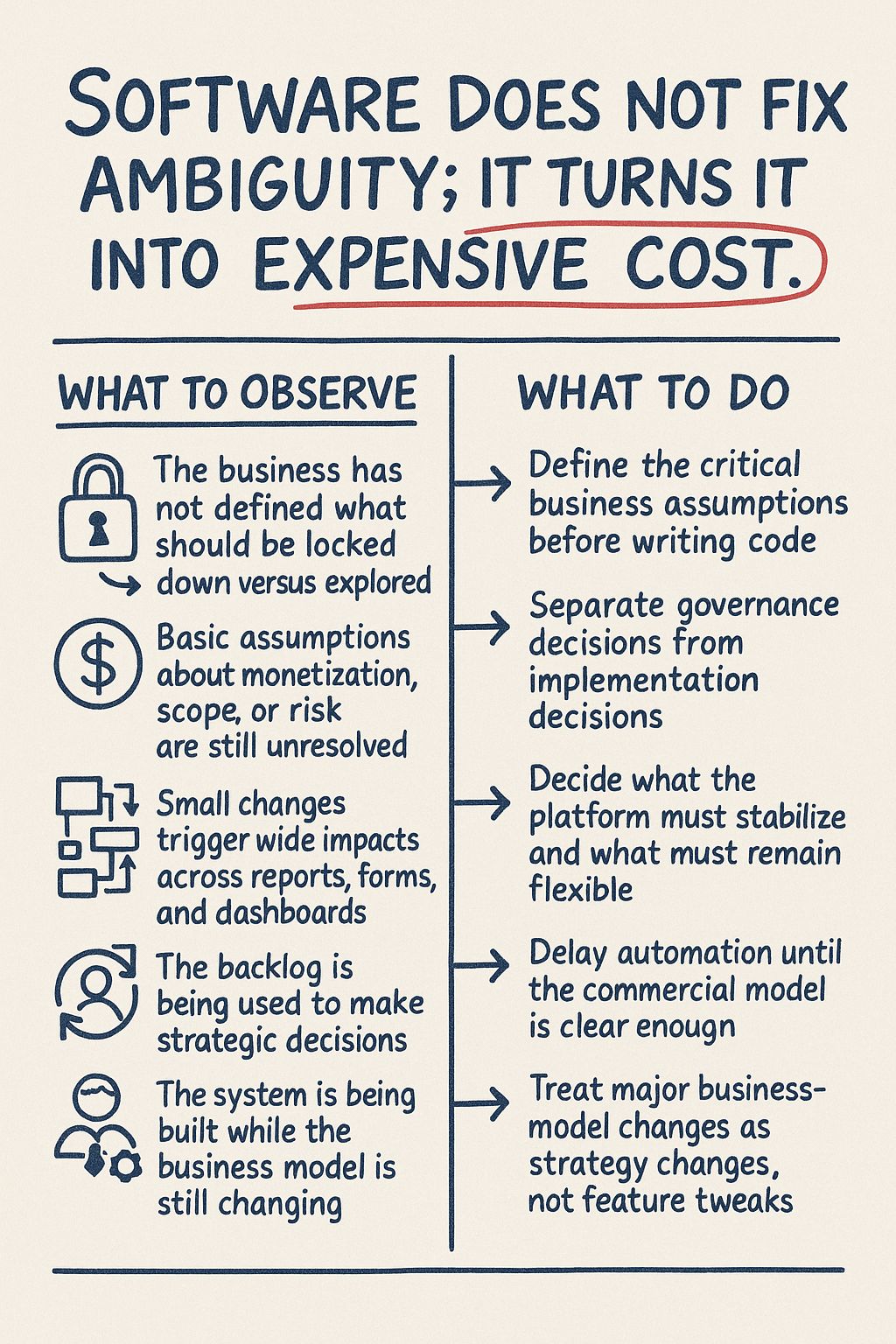
From a CTO perspective, that sets off a fairly clear alarm. When the business has not defined its critical assumptions, software stops executing a decision and starts exploring it at a high cost. That is where rework, architecture changes, technical debt, and contractual friction begin, and all of that spreads through the organization. The apparent speed of the initial launch almost always ends up becoming an operational burden that is hard to unwind.
That is what happened here. The technical team was solid, there was traceability, and the chosen technology made sense. Even so, every business decision took weeks or months to close while the system kept moving forward. A small adjustment could affect diagnostics, forms, reports, and dashboards. The engineering was not poorly designed. The problem was something else: the rules had not yet gained enough stability.
The tension grew when the client moved from a one-off service to a recurring model, with retainers, card payments, and new commercial channels. That change was not a functional tweak. It was another business. And a platform designed to digitize a process should not, by default, bear the responsibility of redefining the commercial direction. When that boundary blurs, technology ends up making decisions that belonged to strategy.
The lesson for any technology leader is simple, but not exactly comfortable. Before writing the first line of code, it is worth deciding what you want to lock down and what you want to discover. Diagnosis, monetization, scope, and change criteria are governance decisions. When those are not resolved, the backlog ends up taking the place of strategy. And that trade-off is usually expensive, because what gets delayed is precisely the clarity the organization needed from the start.
Building less is not always the answer. Sometimes it is about deciding better. Software does not correct ambiguity. It turns it into cost, almost always too late.