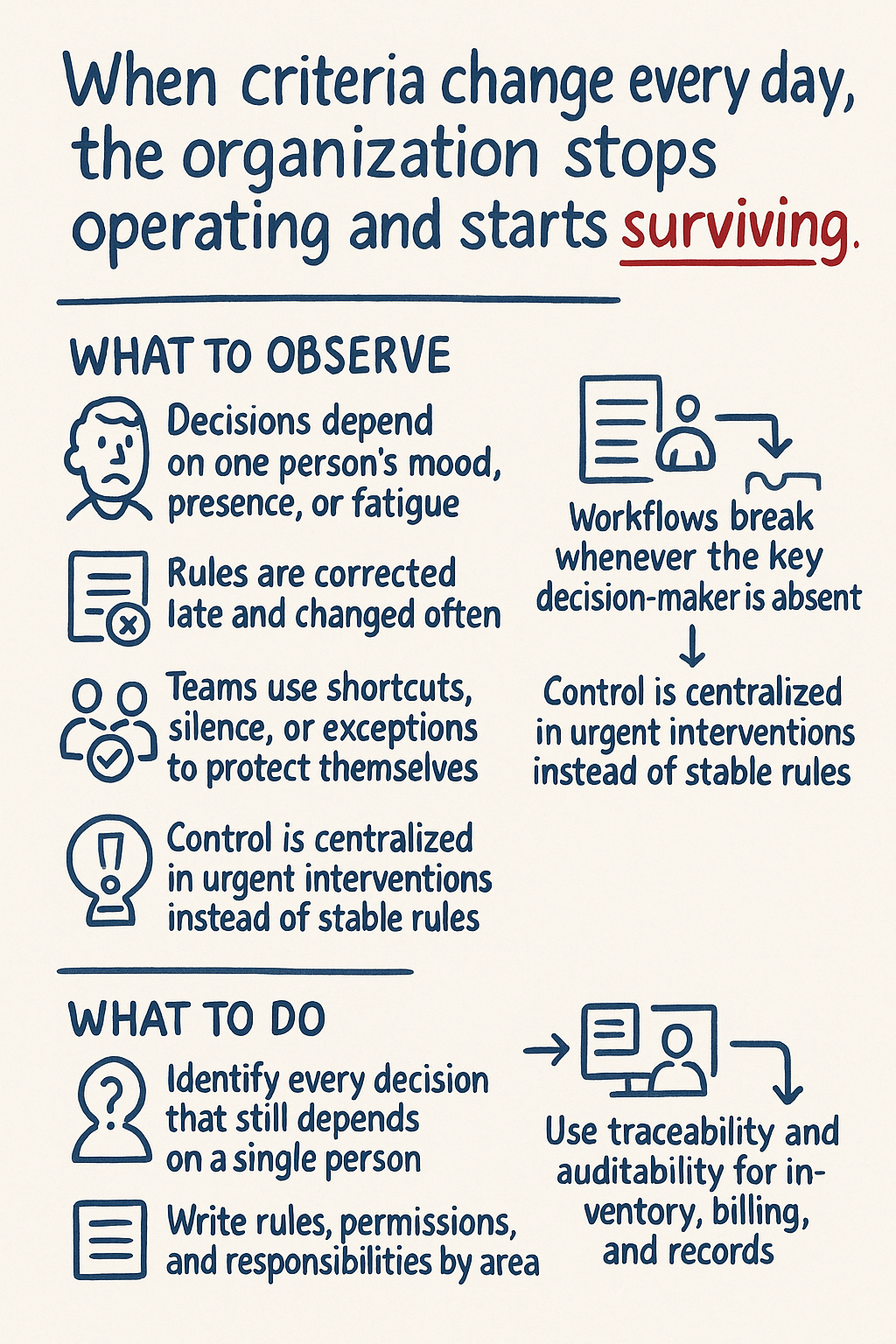
When criteria change every day, operations cease to exist
There are organizations that do not have a process problem. They have an authority problem. And the difference becomes apparent quickly when operations start to depend on decisions that change too easily.
A process can be poorly designed, become slow, or remain incomplete. But when there is a figure who corrects late, corrects often, and also changes their criteria easily, that process stops functioning as a working system and becomes a suggestion. The team quickly understands that today’s rule may not be useful tomorrow, and with that, predictability drops to the floor.
Without predictability, scale breaks. What remains is survival. The organization ends up absorbing uncertainty in every shift, and that wears down any attempt at stability, no matter how “orderly” it may look from the outside.
I have seen that pattern in very different environments, but the case of a veterinary clinic makes it quite clear. A few months ago, I came across an operation that depended too much on its director. Emergencies, inventory, medical validations, billing, and coordination between shifts all ended up passing through her. The team had capacity and the technology existed, but what was happening underneath was that the organization had turned one person into the validation point for almost everything.
As long as the business remained small, that looked like control. In reality, it was a fragile architecture. Every absence, every doubt, and every delay made the dependency more visible, to the point that no one could hide it anymore.
The most serious issue was not the burden on the director, but the team’s reaction. When decisions change depending on the moment, the person who is present, or the level of fatigue of whoever is in charge, people stop following rules and start protecting themselves. Shortcuts, exceptions, silence, and passive resistance appear. Not out of rebellion, but out of simple operational logic. No one invests energy in complying with a rule that may be canceled tomorrow.
That cycle feeds itself. The more management centralizes to correct disorder, the more dependency it creates. And the more the operation depends on that intervention, the more friction any absence, any doubt, or any change in criteria produces. In the end, the organization moves around urgency, not rules.
The solution was not to digitize out of inertia or add a more sophisticated piece of software just because. What was done was to implement an ERP with an electronic medical record and force the organization to put rules, permissions, traceability, and responsibilities by area in writing. Knowledge stopped being trapped in one person’s head and moved into the system.
That does not eliminate human judgment. It limits it. And it also makes something very clear for anyone who has seen an operation grow without enough discipline: technology does not fix a bad governance structure if leadership continues to intervene without a stable criterion. It only accelerates the friction. Properly implemented, yes, it does help separate control from bottlenecks. Inventory becomes traceable, billing becomes auditable, clinical records remain consistent, and improvised decisions are reduced in critical moments.
When authority corrects late and too often, the organization stops trusting the rules. And when that happens, it no longer operates. It survives. For a technology leader, that is the signal worth looking at first, before asking what system is missing.
It is worth reviewing which decision still depends on a single person. That is usually where the bottleneck is, and also the reason the operation never fully stabilizes.