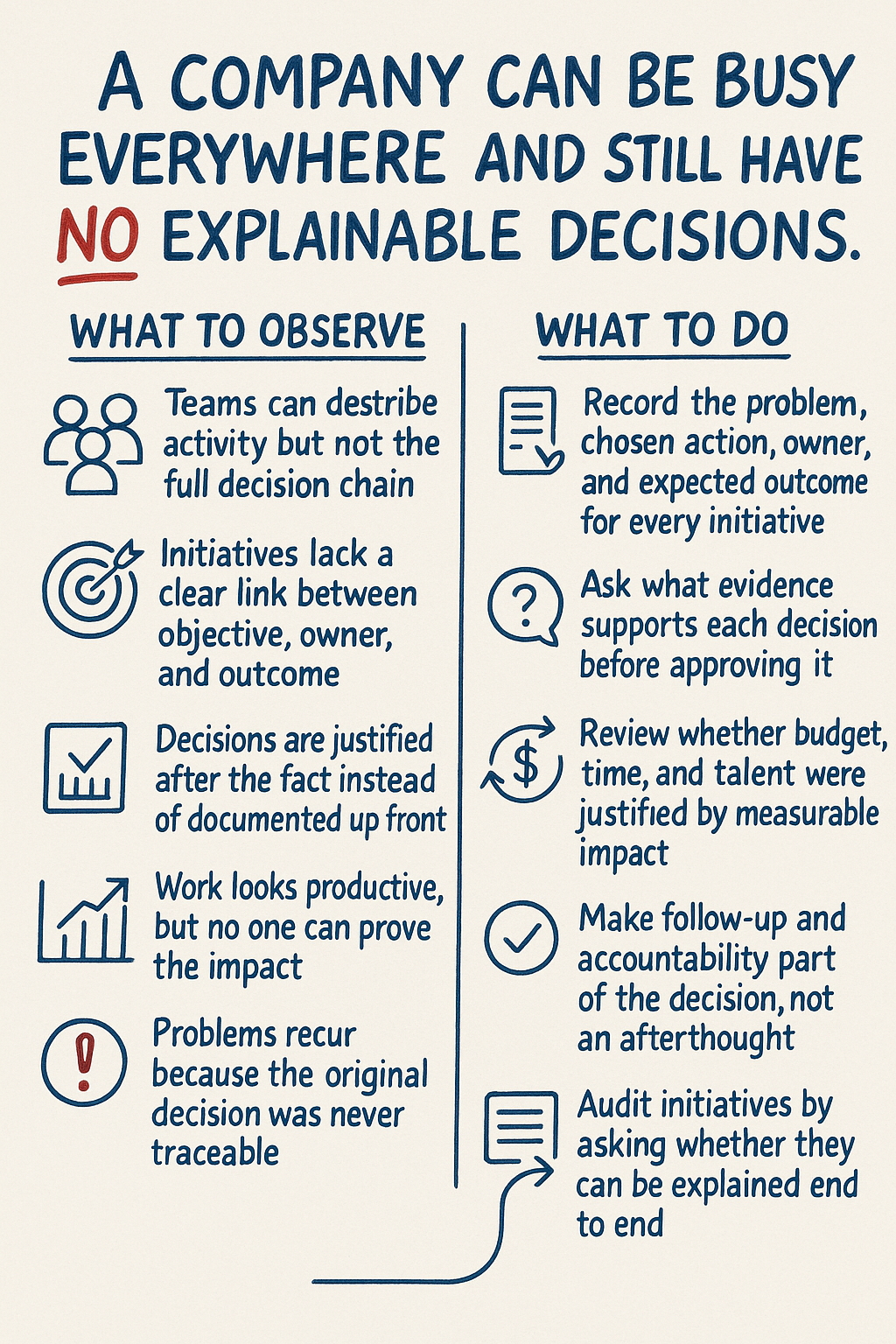
When the company cannot explain its decisions
Some time ago I came across organizations where there was activity everywhere: meetings, dashboards, deliverables, and even people who seemed very busy, but when you tried to reconstruct why a specific decision had been made, no one could put the whole chain together. And that is where the difference becomes clear between a company with judgment and a company that only has stories.
Most teams fail not because they lack ideas. They fail because they cannot show how each step was decided, and that difference matters more than it seems. A company can sustain operations, meetings, and partial results, but if it cannot reconstruct the chain between objective, initiative, investment, owner, follow-up, and outcome, it does not have decision traceability. It has a half-finished narrative that sounds good as long as no one digs too deeply.
From a CTO’s perspective, this is not just an internal communication issue. It is a governance issue. When a technological, operational, or product decision leaves no causal trace, it stops being auditable. After that, no one can tell whether that initiative really generated value, whether it took on reasonable risk, or whether it only consumed capacity on something that sounded good on paper.
This appears more often than we would like to admit. An architecture is reviewed without truly understanding the process it supports. Automation is requested without measuring what friction it removes. A technical reorganization is pushed without identifying the real bottleneck. And then, when the result does not arrive, the organization compensates with retrospective explanations that fit the story, but do not fix the decision that originated it.
The reference material makes this quite clear. It is not enough to talk about treating people well, avoiding drama, or “organizing the environment.” At the executive level, the core question is different. Is there evidence of what problem was being solved, what was chosen, and what consequence it had? If that trail does not exist, there is no serious way to learn. And without structured learning, the same mistake is repeated under another name.
For a technology leader, decision traceability is an operational capability, not a luxury. It makes prioritization auditable, helps understand why budget was assigned to an initiative, and verifies whether the cost in time, attention, and talent was truly justified by the impact. It also removes a very common trap from the leadership committee: confusing motion with progress.
The absence of traceability degrades corporate governance because it erases accountability. If no one knows who decided, with what information, under what constraints, and what follow-up was supposed to exist, no one is truly responsible for the outcome. The company ends up defending comfortable stories instead of correcting the system that produced that disorder.
The important question is not whether an initiative worked well. It is whether it can be explained from beginning to end. Only when a company leaves evidence of its decisions can it be audited, learn, and improve. Everything else is intuition with a good presentation.