When the company needs to decide, not more software
19 September 2026
8 min read
Aritz Pozo
## The company didn’t need more software; it needed the ability to decide
There comes a moment in many organizations when the problem stops being technical and becomes much harder to manage. It’s no longer that a tool is missing. What’s missing is stable judgment. And when that happens, software doesn’t fix operations; at best, it exposes even more clearly the fragility that was already there.
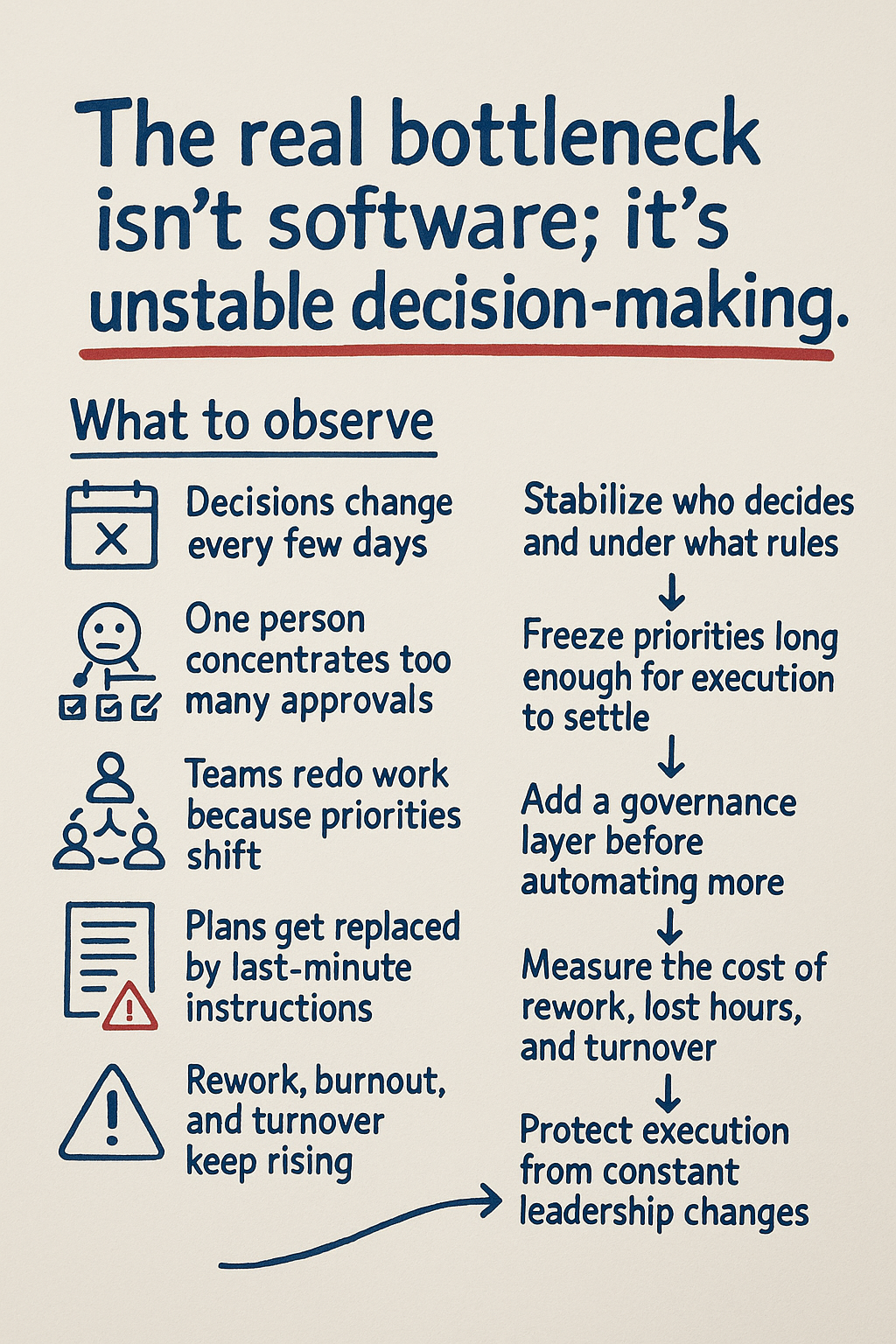
After seeing enough operations up close, that is often one of the clearest signs of operational immaturity. It doesn’t matter how robust the ERP, CRM, or automation layer is if the company changes direction every few days. Technology ends up chasing decisions that never quite settle. What looks from the outside like process chaos often has another root cause: governance.
Closing a decision is not just about approving it. It also means the organization knows who decides, under what rules it is reviewed, and at what point a priority stops moving. Without that stability, timelines don’t break because of a lack of capacity. They break because of volatility in leadership. Teams stop planning rigorously and start improvising, because in the end nobody wants to build on something that may change tomorrow. And over time, turnover, burnout, and rework stop being side effects and become structural costs.
A few months ago, I came across an industrial company right there. They had tried to bring order to their operational complexity with an ERP. They had debt, limited medium-term visibility, and several critical processes all demanding order at once. The problem was not the tool. The problem was that management concentrated too many decisions in one person and there was no real way to sustain a consistent criterion. Every change of mind forced work, schedules, and dependencies to be reorganized. Operations were living behind the latest instruction, which is a very expensive way of working.
And here comes the trade-off that many technology leaders underestimate. Automating before stabilizing governance speeds up disorder. A system can record, trace, and execute, but it does not create continuity or organizational discipline. If the company cannot keep a priority in place long enough, the ERP only makes the back-and-forth faster. It worked, sure, and I put that in quotes a lot, but as a mechanism for amplifying chaos.
The improvement came when execution was protected with a parallel governance layer and the team’s exposure to decision volatility was reduced. It wasn’t an elegant solution, honestly, but it was effective. It made it possible to restore continuity, speed up operational preparation, and measure the real cost of disorder, including rework, lost hours, and turnover. When changes in criteria stopped dictating day-to-day work, progress became visible.
The lesson for any CTO is quite straightforward. Before asking which platform to implement, it is worth asking whether the organization can decide and sustain that decision. Operational maturity begins when the company can close on a criterion, maintain it, and execute it without undoing it a week later. And the uncomfortable question is another one: were you buying software to improve operations, or to hide the fact that nobody could decide?